Film Editing - Writing with Images
Editing is one of the most creative aspects of filmmaking. The film editor, in conjunction with the director, establishes the pace and structure of a film by connecting various shots to create scenes and sequences that form the final movie. The shots the editor chooses and the ways they are combined set the mood, develop the action, create the rhythm, establish the film's time and space, and guide the viewers' attention. For a typical feature-length film, the editor begins with hundreds of thousands of feet of film and must reduce it to less than 10,000 feet.
In the 1920s, Russian filmmaker Lev Kuleshov conducted a series of experiments designed to demonstrate that when two separate shots are projected in succession, the viewer assumes a connection between them. In one experiment, Kuleshov spliced together a series of shots that had been taken in different places and at different times. The shots were of a waiting man, a walking woman, a gate, a staircase and a mansion. Kuleshov's viewers—who interpreted the sequence as a man and a woman meeting at the gate in front of the mansion—had, in essence, inferred a whole narrative on the basis of seeing only portions of it. This effect allows filmmakers to use exteriors and interiors miles apart and imply that they are in the same place, to have people filmed on different days appear to be talking to each other, to have actors seemingly facing dangerous situations, or to imply that what actors are thinking about is represented by a subsequent cutaway image.
The Kuleshov effect is an editing technique that illustrates how the human brain tries to find connections between objects when viewed together. Other editing techniques rely on how the human eye works. For example, there usually must be an appropriate change in distance for a shot not to seem like a mistake or "jump" cut. The direction in which things move across the screen is also an editorial concern. A car that exits the screen on the right is expected in a subsequent shot to reappear on the left—otherwise the car could be perceived as a different car coming from the opposite direction. Scenes featuring characters in opposition to each other (a hero and villain, for example) usually feature one character continually facing one direction with the other character continually facing the other direction. This keeps the two "sides" clear.
Storyboarding
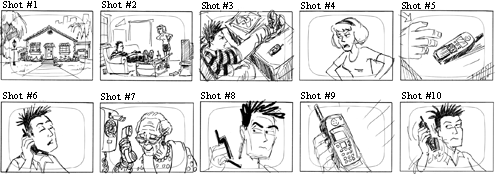
Here is an example of a shot list for the comic strip illustrated below.
1. LS - Exterior of house. Day.
2. LS - Mom to boy. Boy facing right, Mom facing left. "You should call your Grandma."
3. MS - Overhead. Boy staring at phone facing right. Phone on right side of screen.
4. CU - Mom's face. Mom facing left. "You should call your Grandma."
5. ECU - Boy picking up phone. Hand enters from left side of screen.
6. CU - Boy on phone. Phone on left side of screen. Boy's right ear. "Hello, Grandma."
7. CU - Grandma on phone. Grandma facing left. "Why don't you call more often?"
8. CU - Boy staring at phone. Phone on left side of screen.
9. ECU - Phone. Boy's hand on left side.
10. CU - Boy hanging up phone. Phone on left side of screen. Boy looking at phone.

What happens if, instead of the current sequence, the panels are placed in a different order?
Example #1—1, 7, 6, 9, 10, 2 ,3, 4, 5, 8 (Grandma has called the boy from her house and, after hanging up, the boy is told to call his Grandma by his Mom.)
Example #2—5, 8,1, 7, 6, 9, 10, 2, 3, 4 (The boy calls Grandma, she admonishes him, the Mom says to call Grandma, and after he doesn't respond, reminds him again.)
Example #3—1, 3, 7, 5, 6, 9,10, 2, 4, 8 (The boy thinks about calling his Grandma, imagines what she would say, calls her, hangs up, and is told to call her by the Mom.)
Montage
Film editing can have its own unique logic as well, functioning in much the same manner as the brain with seemingly jumbled thoughts and images creating their own individual meaning. The groundwork for many of these techniques, later used by Alfred Hitchcock and others, was laid by a group of Soviet filmmakers—most notably Lev Kuleshov, Sergei Eisenstein and Vsevolod Pudovkin—who, in the early 1920s, began to experiment with film style and technique and especially with montage.
Montage, or collision editing, is done by splicing together a rapid sequence of carefully selected shots to evoke a specific emotional or intellectual response. The Russians' premise was that each shot derived meaning from the context in which it was placed. If the context changed, the meaning of the shot and the sequence also changed.
Montage, in the modern sense of the word, often refers to sequences where several shots have been edited together to compress a series of events that happen over time (e.g., sequences of young couples falling in love, scenes with flying calendar pages, etc.).
Psycho
In Psycho, Alfred Hitchcock's famous shower scene uses a rapid series of extreme close-ups to build suspense and heighten the sense of panic. Many viewers believe they have seen a very brutal stabbing, even though the knife is never shown piercing the body of the victim.
Potemikin
This sequence in Sergei Eisenstein's 'Potemkin', one of the most famous in film history, recounts the brutal suppression of Russian workers and sympathizers following the death of proto-revolutionary figure Vakulinchuk onboard the Potemkin. Crewmen on the ship had mutinied due to oppressive working conditions and when they arrive at Odessa townspeople came to pay respects for Vakulinchuk and support the workers ... the film itself is based upon the failed 1905 Russian Revolution ... the Odessa sequence is a frightening precursor of government suppression of dissent throughout the 2Oth century, including, but certainly not limited, to Hungary (1956), Czechoslovakia (1968), Soweto (1976), Tiananmen Square (1989) - even Kent State (1970).
The Odessa Steps sequence in Eisenstein's The Battleship Potemkin, is the classic example of montage. If possible, show this to your students. In this sequence, the Czar's army is quashing an uprising. Eisenstein uses editing to show the fear of the people, their escalating panic, the tragedy of innocent bystanders as a baby in a carriage careens helplessly down the steps, and the intensifying threat of the soldiers, their guns and artillery.
Source: Young Minds Inspired and The Academy of Motion Picture Arts and Sciences
Editing is one of the most creative aspects of filmmaking. The film editor, in conjunction with the director, establishes the pace and structure of a film by connecting various shots to create scenes and sequences that form the final movie. The shots the editor chooses and the ways they are combined set the mood, develop the action, create the rhythm, establish the film's time and space, and guide the viewers' attention. For a typical feature-length film, the editor begins with hundreds of thousands of feet of film and must reduce it to less than 10,000 feet.
In the 1920s, Russian filmmaker Lev Kuleshov conducted a series of experiments designed to demonstrate that when two separate shots are projected in succession, the viewer assumes a connection between them. In one experiment, Kuleshov spliced together a series of shots that had been taken in different places and at different times. The shots were of a waiting man, a walking woman, a gate, a staircase and a mansion. Kuleshov's viewers—who interpreted the sequence as a man and a woman meeting at the gate in front of the mansion—had, in essence, inferred a whole narrative on the basis of seeing only portions of it. This effect allows filmmakers to use exteriors and interiors miles apart and imply that they are in the same place, to have people filmed on different days appear to be talking to each other, to have actors seemingly facing dangerous situations, or to imply that what actors are thinking about is represented by a subsequent cutaway image.
The Kuleshov effect is an editing technique that illustrates how the human brain tries to find connections between objects when viewed together. Other editing techniques rely on how the human eye works. For example, there usually must be an appropriate change in distance for a shot not to seem like a mistake or "jump" cut. The direction in which things move across the screen is also an editorial concern. A car that exits the screen on the right is expected in a subsequent shot to reappear on the left—otherwise the car could be perceived as a different car coming from the opposite direction. Scenes featuring characters in opposition to each other (a hero and villain, for example) usually feature one character continually facing one direction with the other character continually facing the other direction. This keeps the two "sides" clear.
Storyboarding
Here is an example of a shot list for the comic strip illustrated below.
1. LS - Exterior of house. Day.
2. LS - Mom to boy. Boy facing right, Mom facing left. "You should call your Grandma."
3. MS - Overhead. Boy staring at phone facing right. Phone on right side of screen.
4. CU - Mom's face. Mom facing left. "You should call your Grandma."
5. ECU - Boy picking up phone. Hand enters from left side of screen.
6. CU - Boy on phone. Phone on left side of screen. Boy's right ear. "Hello, Grandma."
7. CU - Grandma on phone. Grandma facing left. "Why don't you call more often?"
8. CU - Boy staring at phone. Phone on left side of screen.
9. ECU - Phone. Boy's hand on left side.
10. CU - Boy hanging up phone. Phone on left side of screen. Boy looking at phone.
What happens if, instead of the current sequence, the panels are placed in a different order?
Example #1—1, 7, 6, 9, 10, 2 ,3, 4, 5, 8 (Grandma has called the boy from her house and, after hanging up, the boy is told to call his Grandma by his Mom.)
Example #2—5, 8,1, 7, 6, 9, 10, 2, 3, 4 (The boy calls Grandma, she admonishes him, the Mom says to call Grandma, and after he doesn't respond, reminds him again.)
Example #3—1, 3, 7, 5, 6, 9,10, 2, 4, 8 (The boy thinks about calling his Grandma, imagines what she would say, calls her, hangs up, and is told to call her by the Mom.)
Montage
Film editing can have its own unique logic as well, functioning in much the same manner as the brain with seemingly jumbled thoughts and images creating their own individual meaning. The groundwork for many of these techniques, later used by Alfred Hitchcock and others, was laid by a group of Soviet filmmakers—most notably Lev Kuleshov, Sergei Eisenstein and Vsevolod Pudovkin—who, in the early 1920s, began to experiment with film style and technique and especially with montage.
Montage, or collision editing, is done by splicing together a rapid sequence of carefully selected shots to evoke a specific emotional or intellectual response. The Russians' premise was that each shot derived meaning from the context in which it was placed. If the context changed, the meaning of the shot and the sequence also changed.
Montage, in the modern sense of the word, often refers to sequences where several shots have been edited together to compress a series of events that happen over time (e.g., sequences of young couples falling in love, scenes with flying calendar pages, etc.).
Psycho
In Psycho, Alfred Hitchcock's famous shower scene uses a rapid series of extreme close-ups to build suspense and heighten the sense of panic. Many viewers believe they have seen a very brutal stabbing, even though the knife is never shown piercing the body of the victim.
Potemikin
This sequence in Sergei Eisenstein's 'Potemkin', one of the most famous in film history, recounts the brutal suppression of Russian workers and sympathizers following the death of proto-revolutionary figure Vakulinchuk onboard the Potemkin. Crewmen on the ship had mutinied due to oppressive working conditions and when they arrive at Odessa townspeople came to pay respects for Vakulinchuk and support the workers ... the film itself is based upon the failed 1905 Russian Revolution ... the Odessa sequence is a frightening precursor of government suppression of dissent throughout the 2Oth century, including, but certainly not limited, to Hungary (1956), Czechoslovakia (1968), Soweto (1976), Tiananmen Square (1989) - even Kent State (1970).
The Odessa Steps sequence in Eisenstein's The Battleship Potemkin, is the classic example of montage. If possible, show this to your students. In this sequence, the Czar's army is quashing an uprising. Eisenstein uses editing to show the fear of the people, their escalating panic, the tragedy of innocent bystanders as a baby in a carriage careens helplessly down the steps, and the intensifying threat of the soldiers, their guns and artillery.
Source: Young Minds Inspired and The Academy of Motion Picture Arts and Sciences
posted by MJ at 5:20 PM


0 Comments:
Post a Comment
<< Home